


![shaftwhores only by [EXE]dann](/files/avatars/2007/51852-shaftwhore.gif "shaftwhores only by [EXE]dann")


PC specs for VR
So what are the real specs to run this 'contraption'? Looking at Oculus Rift's and HTC Vive's website recommended specs are identical. Graphic s wise it means getting nothing less than nVIDIA GTX970 or AMD R9 390 and a CPU Intel i5-4590 (Skylake equivalent being the i5-6500). Your first thought might be that it is not that bad. Well, perhaps it isn't, but don't forget you still have to fork out an additional $600 or $800 for the VR headset. When it comes to RAM the 8GB will be enough, more is not needed unless you want to get into some video editing. As far as storage goes an SSD is always welcome since it will speed up the computer considerably.
Taking into account what has been said, a solid VR build should be like the following:
CPU: Intel Core i5-6500
GPU: GeForce GTX 980 or Radeon R9 390X
Motherboard: Any will do
Storage: 120GB SSD
PSU: 600W or more
RAM: 8GB DDR4
This rounds up to roughly $1000 just for the PC. A cheaper VR experience can be had with a PS4 ($300) and the PS VR headset ($400) for $700 altogether. Another alternative is Samsung Gear VR ($99) and a Samsung Galaxy S6 (cca. $500) for $600, but in all honesty it won't be as immersive as the PC counterparts.
VR and eSports
There are two approaches to eSport matches, one as a player and the other as the spectator. When it comes to playing eSport games such as CS:GO or DotA2 or even Quake/UT there are many drawbacks to using a VR. As was already mentioned previously in the article, it is hard to imagine pro-players scrapping their keyboards, mouse’s and monitors for a VR. Also one must consider the fact that wearing solely headphones after hours of gaming, gets very tiring. Not to mention the fact that you have to move your head around, and in rapid succession to look for your opponent when wearing a VR headset. Neck injuries are waiting to happen. You could argue that the carpal tunnel syndrome is a serious health issue, which it is, but having a strained neck sounds just a bit more serious. You could, also, argue that having a larger field of view helps to see the opponent but you still have to ‘aim’ at him with your head and arms. Probably in the future when games are created with VR in mind we might see something completely different. But the question remains, if we start jumping, crouching and flapping our arms around, wouldn’t that be, well, same as normal sports? The only difference being that you create and imaginary battlefield or arena or characters that don’t exist in the real world. It is certainly something to think about.
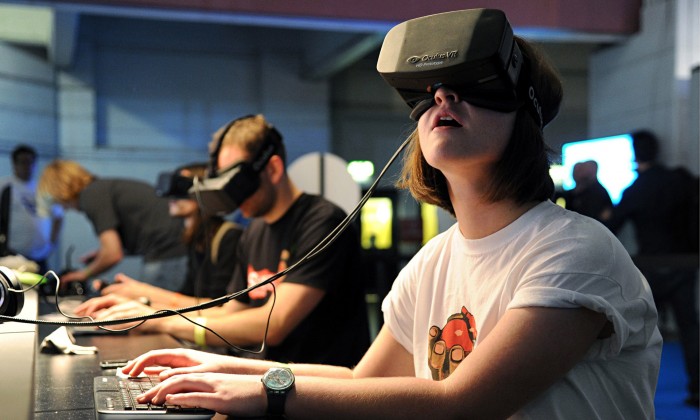
Photo courtesy by www.roadtovr.com
Spectator wise VR has a very bright future! Just imagine all the possibilities. You strap on your VR headset and you dive into your favorite game from a point of view of a pro-player. Or you choose to walk around the map as a bystander with all the action happening around you! Your favorite LAN tournament is on but you can’t travel to it? No, problem. Put your VR on and join the crowd, cheering and following games on a big screen like you are there. Immersive experience at its finest and we can only hope that developers realize the full viewing potential of VR by adapting their games.
Sales and predictions
Fact is, literally billions of US dollars are being channeled into VR development and that raises some questions whether this is another ‘bubble’ waiting to burst? There are numerous prediction reports being released, almost, on a daily basis. And they are all contradictory. You have one research market company saying that the sales will exceed all expectations. The following day another research market company is raising caution flags and arguing for patience. It is certainly clear that a lot is at stake here, money has been invested, and partnerships have been made so it is understandable that certain parties are pushing gloomy predictions away with sunny bright sales figures of pre-orders.
Conclusion
VR is coming and it is here to stay. There’s no doubt that it won’t be successful. It will but to an extent some predictions go? Time will tell. There are different fields of interest where VR is welcome, more than welcome in fact, and it will most probably transform those fields into something we haven’t seen or experienced so far. But we have to admit that there are limitations, not so much hardware wise, but financial for the most part. At the moment it’s an expensive gadget that gains you nothing when it comes to actual gameplay of certain games. You won’t see gamers grabbing these up just to improve their chances in a game but it could help eSports as a spectators sport. We should also welcome the fact there’s not a huge difference between products, HTC Vive and Oculus Rift are very similar spec wise and only some nifty features could help you decide which one is right for you. It also needs to be sad that VR is not only for gaming; its uses are used in architecture, medicine, the military and so on. How big that market is in comparison to the gaming market is yet to be seen. Currently the focus is mostly on games and entertainment and it is up to the software developers to utilize these devices to its full potential.
Sources: gamesindustry.biz, HTC, Oculus, Samsung VR, PS VR, Wareable , Logical Increments
So what are the real specs to run this 'contraption'? Looking at Oculus Rift's and HTC Vive's website recommended specs are identical. Graphic s wise it means getting nothing less than nVIDIA GTX970 or AMD R9 390 and a CPU Intel i5-4590 (Skylake equivalent being the i5-6500). Your first thought might be that it is not that bad. Well, perhaps it isn't, but don't forget you still have to fork out an additional $600 or $800 for the VR headset. When it comes to RAM the 8GB will be enough, more is not needed unless you want to get into some video editing. As far as storage goes an SSD is always welcome since it will speed up the computer considerably.
Taking into account what has been said, a solid VR build should be like the following:
CPU: Intel Core i5-6500
GPU: GeForce GTX 980 or Radeon R9 390X
Motherboard: Any will do
Storage: 120GB SSD
PSU: 600W or more
RAM: 8GB DDR4
This rounds up to roughly $1000 just for the PC. A cheaper VR experience can be had with a PS4 ($300) and the PS VR headset ($400) for $700 altogether. Another alternative is Samsung Gear VR ($99) and a Samsung Galaxy S6 (cca. $500) for $600, but in all honesty it won't be as immersive as the PC counterparts.
VR and eSports
There are two approaches to eSport matches, one as a player and the other as the spectator. When it comes to playing eSport games such as CS:GO or DotA2 or even Quake/UT there are many drawbacks to using a VR. As was already mentioned previously in the article, it is hard to imagine pro-players scrapping their keyboards, mouse’s and monitors for a VR. Also one must consider the fact that wearing solely headphones after hours of gaming, gets very tiring. Not to mention the fact that you have to move your head around, and in rapid succession to look for your opponent when wearing a VR headset. Neck injuries are waiting to happen. You could argue that the carpal tunnel syndrome is a serious health issue, which it is, but having a strained neck sounds just a bit more serious. You could, also, argue that having a larger field of view helps to see the opponent but you still have to ‘aim’ at him with your head and arms. Probably in the future when games are created with VR in mind we might see something completely different. But the question remains, if we start jumping, crouching and flapping our arms around, wouldn’t that be, well, same as normal sports? The only difference being that you create and imaginary battlefield or arena or characters that don’t exist in the real world. It is certainly something to think about.
Photo courtesy by www.roadtovr.com
Spectator wise VR has a very bright future! Just imagine all the possibilities. You strap on your VR headset and you dive into your favorite game from a point of view of a pro-player. Or you choose to walk around the map as a bystander with all the action happening around you! Your favorite LAN tournament is on but you can’t travel to it? No, problem. Put your VR on and join the crowd, cheering and following games on a big screen like you are there. Immersive experience at its finest and we can only hope that developers realize the full viewing potential of VR by adapting their games.
Sales and predictions
Fact is, literally billions of US dollars are being channeled into VR development and that raises some questions whether this is another ‘bubble’ waiting to burst? There are numerous prediction reports being released, almost, on a daily basis. And they are all contradictory. You have one research market company saying that the sales will exceed all expectations. The following day another research market company is raising caution flags and arguing for patience. It is certainly clear that a lot is at stake here, money has been invested, and partnerships have been made so it is understandable that certain parties are pushing gloomy predictions away with sunny bright sales figures of pre-orders.
Conclusion
VR is coming and it is here to stay. There’s no doubt that it won’t be successful. It will but to an extent some predictions go? Time will tell. There are different fields of interest where VR is welcome, more than welcome in fact, and it will most probably transform those fields into something we haven’t seen or experienced so far. But we have to admit that there are limitations, not so much hardware wise, but financial for the most part. At the moment it’s an expensive gadget that gains you nothing when it comes to actual gameplay of certain games. You won’t see gamers grabbing these up just to improve their chances in a game but it could help eSports as a spectators sport. We should also welcome the fact there’s not a huge difference between products, HTC Vive and Oculus Rift are very similar spec wise and only some nifty features could help you decide which one is right for you. It also needs to be sad that VR is not only for gaming; its uses are used in architecture, medicine, the military and so on. How big that market is in comparison to the gaming market is yet to be seen. Currently the focus is mostly on games and entertainment and it is up to the software developers to utilize these devices to its full potential.
Sources: gamesindustry.biz, HTC, Oculus, Samsung VR, PS VR, Wareable , Logical Increments